Price Reset
$
0
199.99
$
$
Price: $0 – $199.99
Sort by

9 products

Filter and sort
Filter and sort

9 products

Availability
Price
$
$
Material
Height range

9 products

WHY CARVED DETAILS CREATE MORE DEPTH

Carved Details Give Light More Places to Settle

Raised leaves catch the light, while grooves and recessed patterns hold shadow. It gives the surface real depth without changing the familiar pedestal shape. From a distance the bird bath reads as one clean form. Up close, the carving is what makes it worth a second look.

A REPEATED MOTIF GIVES THE FORM ITS IDENTITY

One Repeated Motif Can Hold the Whole Design Together

When a leaf, a shell, a scale, or a carved line carries from the basin down through the pedestal, the piece feels whole rather than assembled from separate parts. That repetition gives it a recognizable outline from across the garden, and more to notice up close.

Styling Ornamental Bird Baths

Let One Decorative Language Guide the Whole Garden Corner

An ornamental bird bath already brings carved patterns, sculpted edges, and a clear decorative identity. The garden around it should support that detail rather than compete with it.

Use quiet planting, simple ground materials, and a little open space at the base, so the carving and the basin shape are easy to take in.

Fleur de lis verdigris bird bath styled with broad leaves, low shrubs, pale flowers, gravel, and restrained greenery.

Scrollwork and Botanical Detail

Pair Detailed Ornament with Soft and Simple Greenery

Fleur de lis and scrollwork designs already have a lot of curves and small detail. Broad leaves, low shrubs, a few restrained flowers, and a simple gravel or lawn edge give the carving room to breathe.

Keep decorative urns, patterned planters, and other ornate objects away from it. One detailed piece is enough to give the corner a refined feel.

Shell basin antique bronze bird bath styled beside open lawn, soft grasses, low greenery, pale flowers, and gravel.

Sculpted Basin Forms

Give a Distinctive Basin Shape More Open Space

A shell-shaped basin makes a strong outline before you even notice the finer surface detail. Open lawn, low greenery, soft grasses, and just a few flowers let that outline stay clear.

Keep the area around the pedestal simple, so the basin stays the most recognizable shape in the garden corner.

What ornamental means here

Ornamental, Ornate, Decorative

Ornament is the surface. Underneath it, every piece on this page is a plain pedestal bath.

Decorative bird baths, ornate bird bath, antique concrete bird bath, carved cement bird bath. Four different searches that all arrive at the same request: a bowl on a column with pattern worked into it, rather than a smooth one. That is what this shelf is.

Cast concrete between twenty seven and thirty six pounds, and a lighter resin group at around five. The ornament is the reason to be here, so the sections below are about the ornament itself: where it sits, how it is made, and how it ages.

The traditional pedestal shapes
Relief Cast in Formed in the mold, never applied afterward
Height 22 to 32 in Plus one column that reaches 44
Basin 16 to 20 in Rim pattern eats a little of the width
Weight 4 to 36 lb The heaviest piece on the shelf is the most ornate
Water depth About 2 in Pattern stays outside the wet part

Where the ornament actually sits

A decorated bath has four possible surfaces, and no piece uses all four. Which ones are worked is what separates a quiet piece from a loud one.

01

The rim

Beading, rope, a scalloped edge. This is the one you see from a window, because the rim is the line that catches light. It is also the surface a bird lands on, so the pattern is kept shallow enough to grip.

02

The outside of the bowl

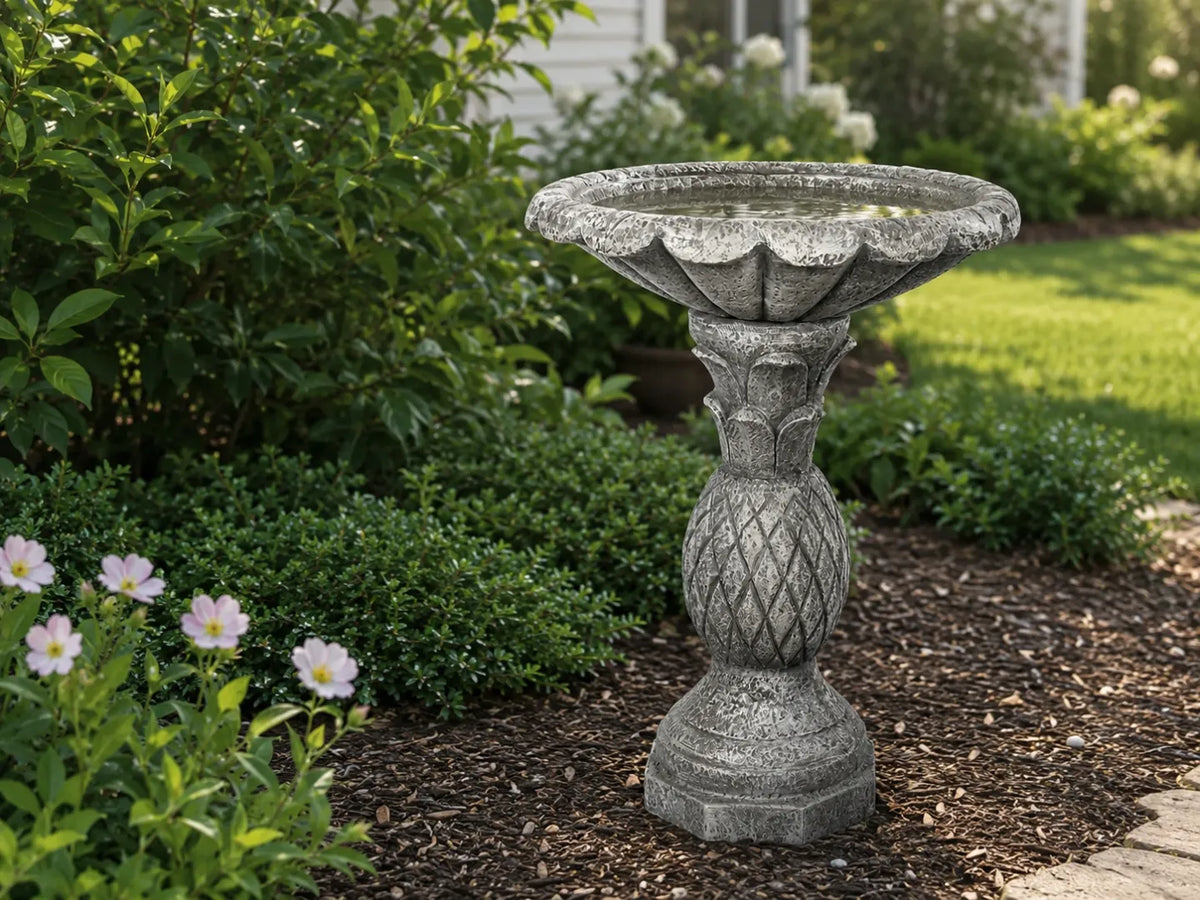
Leaves, shells, gadrooning. The largest curved surface on the piece and the one that carries a full motif. Acanthus leaf works here because it was designed to wrap a curve in the first place.

03

The column

Fluting, twist, a pineapple crown. Vertical pattern reads as height, which is why a fluted column looks taller than a smooth one of exactly the same twenty four inches.

04

The foot

A stepped or square base. Easy to overlook and the thing that decides whether the piece looks planted or perched. Square feet sit better against paving, round against a lawn edge.

Carved, or cast from a carving?

People search for carved stone bird baths and carved cement bird baths, so it is worth being plain about it. Nothing here is carved by hand, one piece at a time. A pattern is carved once into a master, a mold is taken from it, and every bath after that is cast. Hand carved stone at this size is a four figure object.

What casting buys you is depth. Wet concrete reaches into undercuts a chisel would have to fight for, so a cast leaf can curl away from the bowl in a way carved stone rarely does at this price. What it costs you is that every piece of one design is identical. Weather is what makes yours different, and it starts the first winter.

How a leaf pattern gets cast

Detail collects dirt, and some of it you want

An ornate surface holds more than a smooth one. Three of those things are worth keeping and one is not.

01

Shadow in the undercuts

Rain darkens the deep parts and sun bleaches the raised ones. That contrast is the whole reason the pattern reads from across a garden. A piece scrubbed back to one flat gray has lost its ornament.

02

Moss in the grooves

Green in fluting and along a beaded rim is what people pay extra for on reclaimed pieces. On the outside of the bowl and down the column, leave it.

03

Algae in the basin

This one goes. The wet part of the bath is the only surface that needs a weekly rinse, and a soft brush around the inside edge takes about a minute.

04

Leaves in the pattern

Autumn debris packs into deep relief and holds water against the surface all winter. One sweep with a dry brush in November is worth more than any sealant.

One ornate piece, and what goes near it

Ornament competes with ornament. Put a fluted column beside a carved planter and a decorated bench and none of them wins, so the usual approach is one worked piece per sightline with plain surfaces around it. Brick, gravel, clipped box, a mown edge. Quiet neighbors are what let the pattern be seen at all.

Planting works the same way. Fine leaves next to heavy relief, not more relief. Ferns, grasses and lavender read as texture and hold their shape without arguing with the carving. Keep the flight path in mind too, because a bath surrounded closely by tall planting is one birds will look at and not use.

Height, sightlines and placement

Common Questions

Ornamental Bird Baths FAQ

What is an ornamental bird bath?

It is a bird bath where carved patterns, sculpted edges, decorative motifs, or a distinctive basin shape are a main part of the design. The decoration might run around the basin, across the pedestal, along the base, or through the whole piece.

What is the difference between an ornamental and a classic bird bath?

Ornamental describes the physical decoration, the carving, scrollwork, fluting, or sculpted borders. Classic describes the overall traditional feel. A lot of ornamental pieces also read as classic, but a classic design can use simpler proportions and less decoration.

How do I choose between a highly detailed and a simpler ornamental design?

Go with a highly detailed design when it will be seen up close and you want the carving to be part of the experience. Go simpler when it sits further away or the garden around it is already busy, so the shape still reads clearly.

Where should an ornamental bird bath be placed?

Somewhere it can be seen and appreciated, with a calm background and a little open space so the detail stands out. A spot you pass or view often is ideal, since the carving rewards a closer look.

Are carved details difficult to clean?

Not really. Empty and rinse the basin as usual, and use a soft brush to work debris out of the carved grooves. Skip abrasive pads and harsh cleaners, and follow the care instructions for the piece.

Can an ornamental bird bath stay outside during winter?

It depends on the material and how the piece is made. Before freezing weather, drain the basin fully, clean and dry it, and follow the storage or protection instructions on the product page. Do not let water sit and freeze in the basin.